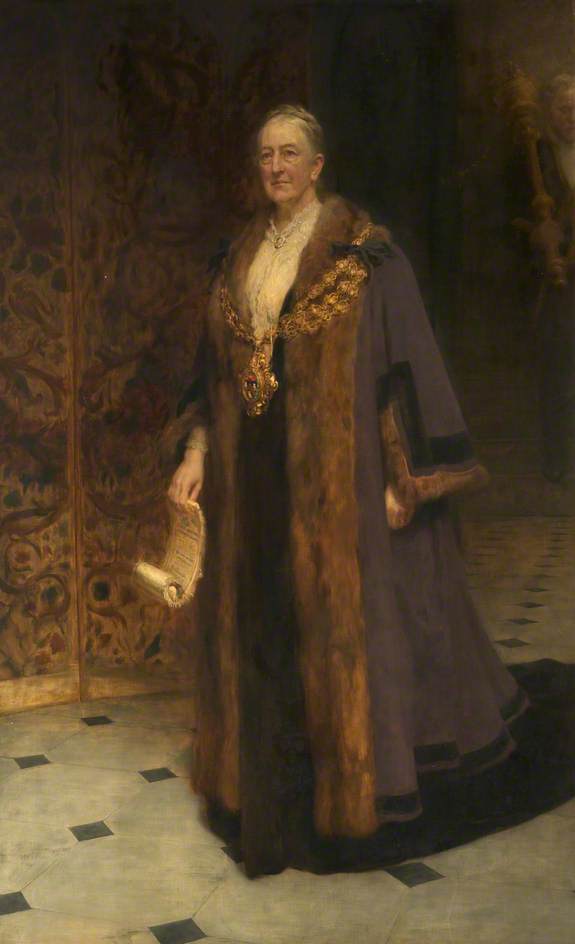
 Sarah Anne Lees (née Buckley; November 13, 1842 – April 14, 1935) was a prominent British philanthropist, local government pioneer, and the first female mayor in the county
of Lancashire.
Sarah Anne Lees (née Buckley; November 13, 1842 – April 14, 1935) was a prominent British philanthropist, local government pioneer, and the first female mayor in the county
of Lancashire.Queer Places:
Manchester Crematorium, Barlow Moor Rd, Chorlton-cum-Hardy, Manchester M21 7GZ, United Kingdom
Sarah Anne Lees (née Buckley; November 13, 1842 – April 14, 1935) was a prominent British philanthropist, local government pioneer, and the first female mayor in the county
of Lancashire.
Sarah Anne Buckley was born on 13 November 1842. In 1864, she married Charles Edward Lees, a wealthy cotton mill owner belonging to a prominent industrialist family in Oldham, Greater Manchester. The couple had several children, including Marjory Lees. Following the death of her husband in the late 1890s, Sarah inherited a substantial fortune, which she dedicated almost entirely to civic improvement, social reform, and philanthropy.
Lees became deeply involved in the social welfare of Oldham, working alongside local activists to address poverty, housing shortages, and women's destitution. Her key achievements include:
She was a tireless advocate for community health and education. In 1907, she became one of the first women elected to Oldham Town Council.
In November 1910, Sarah Anne Lees was elected Mayor of Oldham, making her the first female mayor in Lancashire and one of the earliest female mayors in British history. In recognition of her immense service to the borough, she was later made an honorary Freeman of Oldham.
She supported environmental and urban planning reforms, notably selling land at cost price to help establish the Oldham Garden Suburb to improve living conditions for working-class families.
She passed away on 14 April 1935 at the age of 92.
Sarah Anne Lees is historically tethered in social reform archives to Mary Higgs, a pioneering social investigator, feminist, and Girton College graduate who famously went undercover as a tramp to expose the harrowing conditions of Victorian casual wards and common lodging houses.
The two women met when Higgs moved to Oldham in 1891 after her husband, Reverend Thomas Kilpin Higgs, took up a ministry at Greenacres Congregational Church. Higgs began visiting the local workhouse and formed a deep, lifelong alliance with Sarah and her daughter, Marjory Lees.
When Mary Higgs was widowed in 1907 and faced displacement, Sarah and Marjory Lees made a cottage at Bent House available to her, creating a shared hub for social activism, welfare organizations, and reform movements in Oldham for decades.
While modern historians frequently group Sarah Anne Lees and Mary Higgs together under the lens of women's history, domestic partnership, and nineteenth-century female networks, specific caveats apply regarding LGBTQ+ categorization:
There is no historical or archival evidence to suggest that Sarah Anne Lees and Mary Higgs shared a romantic or sexual relationship. Both women lived within traditional Victorian marital structures prior to being widowed, and their bond was rooted in a shared, fierce commitment to Christian philanthropy, social justice, and feminist reform.
In broader LGBTQ+ historical studies, the intense, lifelong domestic and professional partnerships of Victorian and Edwardian women (such as female reformers living together, sharing households like Bent House, and rejecting traditional dependence on men) are often studied alongside queer history. While Higgs and Lees are not documented as romantic partners, their close communal living arrangement mirrors the kind of independent female-led households that allowed women of that era to bypass conventional patriarchal paths.
References:
Support this project
This website is a passion project researched, developed, and funded entirely by me. If you find the content valuable and would like to help support the ongoing research and hosting costs, any contribution is deeply appreciated.
Thank you for keeping this independent resource alive!
My books on Amazon: Elisa Rolle's books